COP 30 Belém Takeaways: U.S. Business Fills Federal Climate Gap | ASBN
By Michael Green
As I arrived in Belém for COP 30, the UN climate summit focused on forest conservation and business climate action, I immediately noticed the sweet smell of mangos. To my surprise, I spent my COP 30 commute navigating the busy streets of Belém, dodging the fruit that had fallen from the tree-lined streets. While I was ready for the heat, I quickly realized that I wouldn’t be ready for everything this busy week of meetings with American and international allies, foreign governments and speaking engagements was going to throw at me.
In many ways, Belém sits at the doorstep of global forest conservation, and as such, COP 30 in Belém was unlike any UN climate summit we’ve attended. The energy of the Amazon, the urgency reflected in global negotiations, and the glaring absence of U.S. federal leadership all shaped a week that underscored one thing clearly: American businesses cannot sit on the sidelines.
When public-sector leadership falters, private-sector actors, civil society, and mission-driven networks like the American Sustainable Business Network (ASBN) must continue to show up. Not only to advocate for ambitious policies at home, but to demonstrate to the world that the United States still has a robust climate movement pushing for progress.
This blog offers reflections on four key themes from COP 30 and explains why ASBN continues to prioritize on-the-ground presence at international climate negotiations.
For 10 years, ASBN has attended COP meetings to ensure that American businesses—particularly mission-driven, sustainability-focused companies—have a seat at the table. This year, that presence mattered more than ever.
 The U.S. federal government’s visibility at COP 30 was strikingly reduced. Key agency officials were absent. Congressional participation, already limited in most years, was virtually nonexistent because the end of the shutdown happened as the COP kicked off, pulling congressional leaders back to the states. It was the most significant leadership gap from the U.S. we have seen in over a decade of attending these summits. I did see some former US negotiators and leaders who have moved into other positions of Philanthropy or on with big NGOs, but there was essentially no one there in any official capacity (except for Gavin Newsom, who looked like he was spending as much time trying not to melt as he was poking fun at the current administration).
“It was the most significant leadership gap from the U.S. we have seen in over a decade of attending these summits.”
– Michael Green on U.S. federal absence at COP 30
This absence created both a moral vacuum and a strategic one. Other nations sensed an opportunity to step forward—to shape rules, markets, finance flows, and the norms of global cooperation. While it is encouraging to see emerging leadership from countries in the Global South, the vacancy left by the United States carries real consequences for American competitiveness and our ability to influence the future architecture of global climate governance.
In this context, ASBN’s presence took on new urgency. We were in Belém to showcase American private-sector leadership across clean energy deployment, carbon-market integrity, climate finance and climate-resilient investments. Hold our government accountable by demonstrating that climate action remains a top priority for U.S. businesses, even when Washington sends mixed signals. And lastly, build coalitions with Indigenous organizations, global NGOs, universities, development banks, and businesses from around the world to advance shared goals.
When the U.S. government steps back, ASBN steps forward. Our network represents thousands of businesses that understand that climate leadership is not optional—it is foundational to economic stability, supply-chain resilience, and global competitiveness.
Usually I spend most of my time in this section of the COP debrief discussing carbon market policy, as that is a space where I usually call home however most of the political debate there was pushed off until 2027 and this COP was set to focus on other key issues, mainly a coordinated shift away from fossil fuels (spoiler: we didn’t get that) and a renewed commitment towards forest conservation efforts.
The Brazilian presidency attempted to elevate the role of Indigenous communities to an unprecedented level. Depending on who you ask, this was either successful or not. From my perspective, Indigenous leaders shaped discussions inside the negotiating halls, but also outside them, offering a powerful moral clarity about land rights, biodiversity protection, and the need for climate finance that truly flows to the communities safeguarding the Amazon. I saw greater representation from these communities than at any previous COP.
One of the signature outcomes was Brazil’s announcement of its new Tropical Forest Forever Facility (TFFF), a platform to mobilize public and private finance for forest protection, sustainable livelihoods, and Indigenous-led conservation. The initiative gained significant momentum throughout the week, with multiple governments and philanthropic actors signaling interest in contributing. The original call was to raise over $100 billion (currently only ~$5 billion pledged), and while they are short of this goal, I am encouraged to see the commitments being made.
“Companies want to support high-integrity forest projects, but they need governments to build clear, transparent, and credible pathways for private capital to flow responsibly..”
– Michael Green on U.S. federal absence at COP 30
The private sector is increasingly willing and eager to invest in nature-based climate solutions. Companies want to support high-integrity forest projects, ecosystem restoration, Indigenous stewardship, and Article 6-aligned mitigation efforts. But they need governments to continue building clear, transparent, and credible pathways for private capital to flow responsibly and at scale. This will hopefully create greater capacity to this end.
COP 30 made it evident that forest protection will be one of the defining arenas of climate ambition this decade. Brazil is stepping into a leadership role—and U.S. institutions must remain engaged if we want to shape the standards, build strong partnerships, and ensure that American businesses remain at the forefront of this emerging global market.
According to the NDC Tracker, current national climate commitments still fall dramatically short of what science demands. Even when fully implemented, today’s Nationally Determined Contributions (NDCs) – a country’s climate action plan to reduce greenhouse gas emissions under the Paris Agreement – leave us far off the trajectory needed to limit warming to 1.5°C.
COP 30 served as both a moment of global stocktaking and a sobering reminder of the widening gap between ambition and action. Countries acknowledged the shortfall, but the political uncertainty surrounding multilateralism, combined with shifts in global geopolitics, has made it harder for nations to increase ambition and political will at the pace required.
The United States’ inconsistent posture played a significant role. Without strong U.S. leadership, many countries were reluctant to announce aggressive NDC updates or commit to bold new finance pledges. The world is still looking to the United States for direction, even when we fail to show up.
“The world is still looking to the United States for direction, even when we fail to show up.”
– Michael Green on U.S. climate leadership expectations
Yet within this sobering assessment, we saw bright spots. In the few months running up to COP, we saw many new NDCs get sent in by governments. Countries like Brazil and Indonesia signaled new commitments tied to forest protection. Several African nations emphasized their interest in private-sector partnerships and Article 6-aligned cooperation. A growing coalition of countries expressed support for scaling carbon removals, climate-resilient agriculture, and sub-national climate action.
The gap is real, but the momentum for solutions is also real. The world isn’t waiting for perfect conditions – innovators, investors, and communities are driving climate action even amid political ambiguity.
As we left Belém, one message felt clearer than ever: the climate movement is evolving into a public-private ecosystem where business leadership is no longer supplemental—it is essential.
To increase climate ambition at local, state, national, and international levels, we need sustainable businesses that invest not only in their own decarbonization but also in catalytic climate solutions. Companies that advocate for strong policies, fair markets, and build that political will. Private-sector voices that hold governments accountable for inaction and push them toward higher ambition. Networks like ASBN bring these voices together into a powerful, values-driven coalition.
Climate action and progress are no longer something that can be delegated to governments alone. The private sector is innovating faster, deploying capital more nimbly, and embracing climate solutions at a scale that is shifting what is possible. We need to harness this power and shift the narrative from climate pessimism to climate optimism.
“Climate progress is no longer something that can be delegated to governments alone. The private sector is innovating faster, deploying capital more nimbly.”
– Michael Green on business-led climate action
COP 30 made one thing unambiguous: American businesses must continue to lead—globally, visibly, and unapologetically. When we show up, we fill the gaps left by inconsistent politics. When we invest, we drive new markets. When we speak up, we move policy and shine a light for others to follow. And when we partner with global allies, we accelerate the transition to a more sustainable, equitable, and prosperous future.
ASBN will continue showing up because the world needs American leadership, and because our members are ready to provide it.


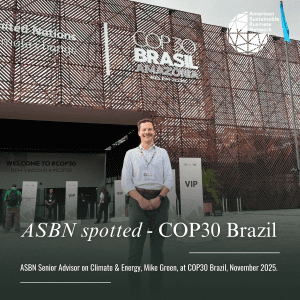 The U.S. federal government’s visibility at COP 30 was strikingly reduced. Key agency officials were absent. Congressional participation, already limited in most years, was virtually nonexistent because the end of the shutdown happened as the COP kicked off, pulling congressional leaders back to the states. It was the most significant leadership gap from the U.S. we have seen in over a decade of attending these summits. I did see some former US negotiators and leaders who have moved into other positions of Philanthropy or on with big NGOs, but there was essentially no one there in any official capacity (except for Gavin Newsom, who looked like he was spending as much time trying not to melt as he was poking fun at the current administration).
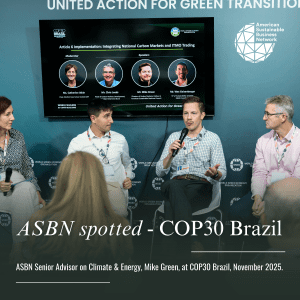 COP 30 served as both a moment of global stocktaking and a sobering reminder of the widening gap between ambition and action. Countries acknowledged the shortfall, but the political uncertainty surrounding multilateralism, combined with shifts in global geopolitics, has made it harder for nations to increase ambition and political will at the pace required.
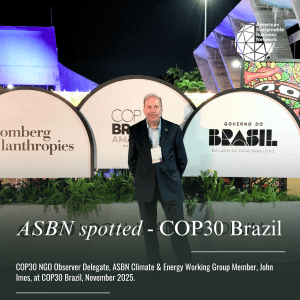 To increase climate ambition at local, state, national, and international levels, we need sustainable businesses that invest not only in their own decarbonization but also in catalytic climate solutions. Companies that advocate for strong policies, fair markets, and build that political will. Private-sector voices that hold governments accountable for inaction and push them toward higher ambition. Networks like ASBN bring these voices together into a powerful, values-driven coalition.