


Author: Abby Maxwell
Editors: Anayana White
Only 42% of workers feel confident their employer has a plan to keep them safe from extreme heat and poor air quality, even as climate-driven hazards reshape the nature of work itself. Recent extreme weather events serve as a stark reminder that the risks associated with climate change continue to escalate.
The American Sustainable Business Network (ASBN) recently convened a policy forum to address this gap, bringing together David Leathers from the Health Action Alliance and Charlotte Brody from the Blue Green Alliance and National Commission on Climate and Workforce Health to discuss what responsible employers need to know — and do — right now.
The numbers tell a stark story. In just the last year, the U.S. experienced 23 billion-dollar weather disasters. While extreme heat is the deadliest risk exacerbated by climate change, workers also face threats from poor air quality, severe weather disasters, drought, and the geographic expansion of vector-borne diseases like Lyme, dengue, and Zika.
“Extreme weather is already changing how Americans work,” said David Leathers. “We know that we’re living in a climate now that has never existed with humans in this way before, and therefore, work is existing in a way that is not like the past. And so, it is our intention to help educate and engage companies on these issues.”
These climate hazards don’t just affect people; they deeply impact business operations.
Extreme weather contributes to increased healthcare spending, rising workers’ compensation claims, greater absenteeism, and significant productivity losses. School closures due to heat events can prevent employees from coming to work at all.
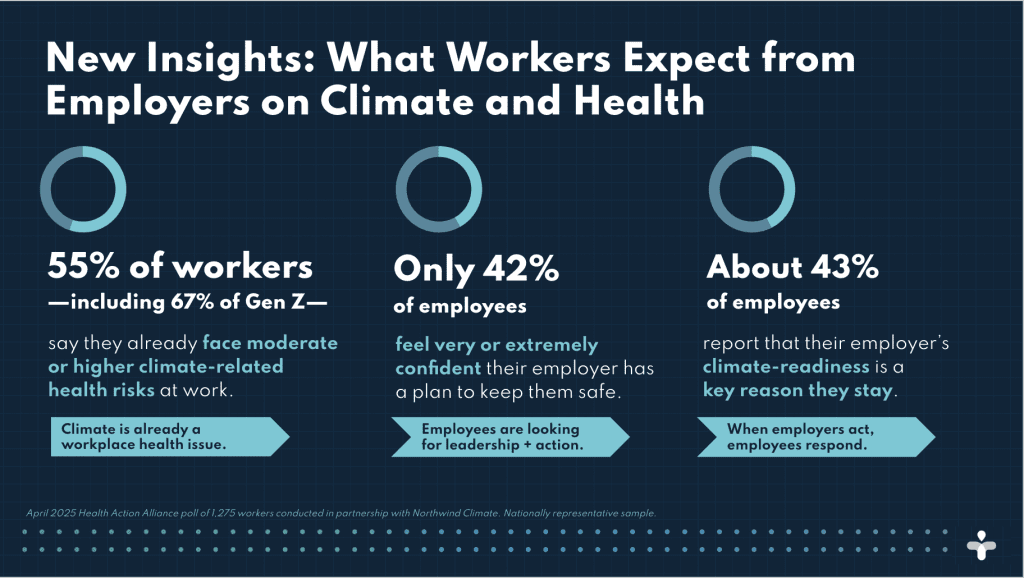
Over half of workers—including two out of three Gen Z workers— already report facing climate-related risks on the job.
Extreme heat poses severe threats across all industries. Construction workers are 13 times more likely to die from heat on the job, but the danger is not limited to outdoor work; it extends to anyone working in spaces without adequate cooling, or moving repeatedly between hot vehicles and job sites.
The federal rulemaking process is slow by design; the average federal OSHA rule takes seven years from announcement to finalization. Relying solely on federal action leaves many workers vulnerable to heat stress. Although the Biden administration released a federal heat protection rule in August 2024, congressional efforts are now actively working to block it from taking effect.
In the absence of federal action, several states are leading the way. Maryland, Oregon, and California already have comprehensive rules covering both indoor and outdoor heat exposure. Additionally, Virginia’s State House and Senate recently passed bills directing their state OSHA to draft a new heat protection rule, alongside active efforts in states like Vermont, New York, New Jersey, and Illinois. For a map of where your state stands, see NRDC’s occupational heat safety standards tracker.
What a Strong Workplace Heat Safety Plan Looks Like
“Every workplace needs a plan for when it gets hot,” Charlotte Brody emphasized, “and even stronger protections for when it gets really hot.” That includes fully air-conditioned offices. Cooling system failures happen, and every workplace needs an emergency protocol for when they do.
A robust workplace heat safety strategy should include:
- ◆ Acclimatization: Workers must be given time to gradually adjust to high temperatures, as many heat-related deaths occur during a worker’s very first week on the job.
- ◆ Employee Involvement: Heat risk assessments should actively involve employees to accurately identify where and when the job gets dangerously hot.
- ◆ Hierarchy of Controls: Employers should prioritize highly effective cooling measures, recognizing that actual air conditioning is vastly superior to minor interventions like applying cool packs.
- ◆ Basic Necessities: Employers must ensure reliable access to cool water, shade, and rest breaks.
- Buddy Systems and Communication: Implementing a system where everyone at risk has a designated buddy or supervisor actively watching them for heat stress symptoms.
- ◆ Training and Emergency Protocols: Providing comprehensive education on the symptoms of heat stress, compounding factors like diabetes or protective clothing, and clear emergency response procedures.
The Business Case for Acting on Extreme Heat Now
Ultimately, understanding and preparing for extreme heat and climate impacts presents a real opportunity for businesses to lead. Employers who get ahead of heat safety aren’t just doing right by their workers — they’re controlling workers’ comp and healthcare costs, retaining talent, and reducing liability exposure. Strong internal standards also make the case for comprehensive policy, which benefits every responsible employer by raising the floor across their industry.
ASBN regularly convenes business leaders, policy experts, and advocates to tackle the challenges — and opportunities — that come with operating in a changing climate. If your business wants to be part of these conversations, join us.
###
American Sustainable Business Network (ASBN) amplifies the collective voice of sustainable business to lead the way to a regenerative economy that is stakeholder-driven, just, and prosperous. As a multi-issue, membership organization advocating on behalf of every business sector, size, and geography, ASBN works to advance its mission to inform, connect, and mobilize sustainable business leaders, transforming the public and private sectors toward a just and regenerative economy.
Take Action: How You Can Support Our Climate & Energy Policy Work
Watch the full recording of the webinar to learn more! ASBN members have access to all webinar recordings. Members, check your emails for the link. Not a member? Learn more about membership and join today.
Learn more about our Climate & Energy work.